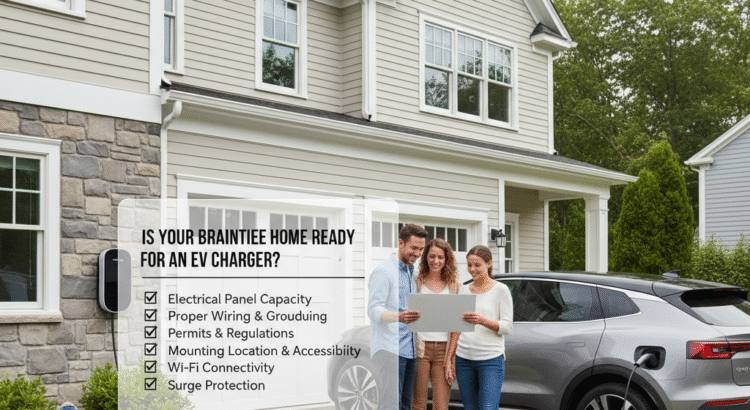
Making the switch to an electric vehicle is an exciting step towards a greener and more cost-effective way of driving. One of the biggest advantages of owning an EV is the convenience of charging it at home, but before you can enjoy that benefit, it’s crucial to ensure your Braintree home is ready for a new EV charger.
Professional installation is not just a recommendation; it is a safety requirement. A qualified electrician will assess your home’s electrical system to ensure it can handle the extra load. To help you prepare for this process and understand what to expect, here is a pre-installation checklist to consider.
1. Assess Your Parking Situation
The first and most fundamental requirement for a home EV charger is dedicated, off-street parking. This is a prerequisite for most installations and is essential for safety. Whether you have a driveway or a private garage, the charger needs to be mounted in a location that allows the charging cable to reach your car without creating a tripping hazard on a public pavement or road. The closer the charger can be to your parking spot, the better, as this minimizes the length of the cable run and can reduce installation costs.
2. Check Your Home’s Electrical Supply
The heart of your EV charger installation is your home’s electrical system. Most residential EV chargers in the UK operate at 7kW (Level 2), which is significantly more powerful than a standard wall socket (Level 1). Your electrician will need to verify that your home’s main fuse can support this extra demand. While most modern UK homes have a main fuse of 60 to 100 amps, some older properties may require an upgrade by the Distribution Network Operator (DNO).
The charger also needs to be on a dedicated circuit, protected by its own circuit breaker (RCD or RCBO) in your consumer unit (fuse box). This is a vital safety measure to prevent overloading and potential fire hazards. Your installer will check the capacity of your consumer unit and may need to install new circuit protection to ensure the setup is compliant with all regulations, including BS 7671.
3. Understand Your Charger Options
The market offers a wide variety of chargers, and it’s helpful to have an idea of what you want before the installer arrives. Do you prefer a “tethered” charger, which has a cable permanently attached, or an “untethered” one, which allows you to use your car’s own cable? Consider “smart” chargers, which are now a legal requirement for new installations in the UK. These chargers can connect to your Wi-Fi, allowing you to schedule charging for cheaper off-peak hours and monitor energy usage via an app. A reliable Wi-Fi signal at the installation point is therefore a key consideration.
4. Secure Permission and Documentation
If you are not the homeowner, you must get written permission from your landlord or property management company before any installation work begins. For listed buildings or properties in a conservation area, you may also need to check if planning permission is required with Braintree’s local authority. Once the installation is complete, a reputable electrician will provide you with an Electrical Installation Certificate (EIC). This is an essential document that proves the work was carried out safely and legally, and it’s something you should keep for your records.
Click the link to learn more: https://alkagelectrical.co.uk/vehicle-charger-installation-braintree/
By taking the time to consider these points, you can ensure a smooth and successful EV charger installation process, putting you on the fast track to convenient and cost-effective home charging.